
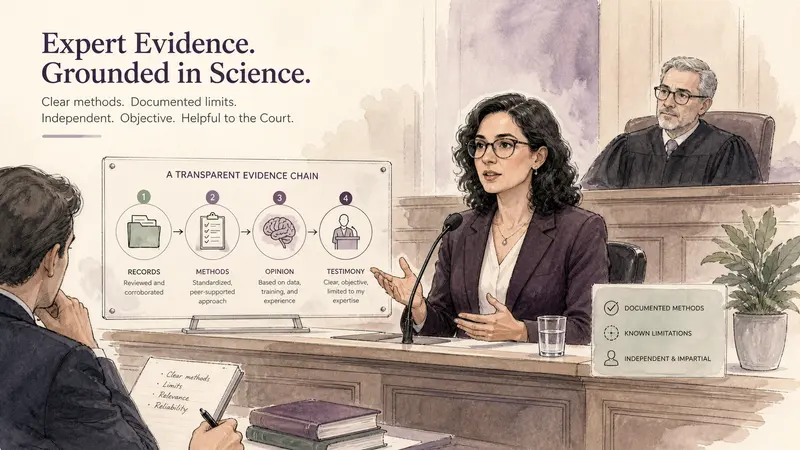
KEY TAKEAWAYS
- The court, not the psychologist, retaining lawyer or curriculum vitae, decides whether proposed expert testimony is admissible.
- Federal Rule of Evidence 702 asks whether specialized knowledge will help, whether the basis is sufficient and whether reliable methods were applied reliably.
- A treating clinician can describe treatment facts, but a psycholegal opinion ordinarily requires a separate forensic foundation and clear role boundaries.
- Payment by one side does not make an expert an advocate; it does create a context in which independence and bias safeguards matter.
The label expert witness can sound like a permanent credential. It is not. Qualification is tied to a specific witness, subject, opinion and proceeding. A highly experienced psychologist may be qualified for one question and not another, while a court may limit or exclude an opinion that exceeds the underlying data or method.
What is an expert witness psychologist?
An expert witness psychologist is a psychologist permitted to use specialized psychological knowledge to help a court or other tribunal understand evidence or determine a relevant fact. The psychologist may educate the factfinder about research, evaluate a person, review records, critique methods or offer a case-specific opinion.
The role is broader than criminal trials. Psychological experts may appear in competency, criminal responsibility, civil injury, employment, disability, family-law and professional-standard matters. The legal question determines what information is relevant; the expert's professional discipline determines what methods can support the answer.
Expert witness versus treating or fact witness
A treating psychologist knows a patient through care. An independent forensic expert gathers information for a legal question. Both may testify, but their foundations and boundaries differ.
| Role | What the witness can contribute | Core boundary |
|---|---|---|
| Expert witness | Specialized principles, methods and opinions that may go beyond ordinary knowledge. | Must stay within demonstrated competence, sufficient data and reliable reasoning. |
| Treating clinician | Treatment history, observations, diagnosis, progress and prognosis within the clinical relationship. | Treatment data may not provide the neutral, multi-source foundation for a psycholegal opinion. |
| Fact witness | Personal observations or events the witness directly perceived. | Does not offer an expert opinion merely because the witness has professional credentials. |
The APA Specialty Guidelines note that testimony based only on psychotherapy does not ordinarily become forensic practice. Offering an opinion on a psycholegal issue, such as trial competence, criminal responsibility or parenting arrangements, ordinarily does.
How does a psychologist qualify as an expert witness?
In U.S. federal court, Federal Rule of Evidence 702 allows a witness qualified by knowledge, skill, experience, training or education to testify when the proponent shows, more likely than not, that four conditions are met:
- 01
Helpfulness
The specialized knowledge will help the judge or jury understand evidence or determine a fact in issue.
- 02
Sufficient basis
The testimony rests on sufficient facts or data.
- 03
Reliable methods
The testimony is the product of reliable principles and methods.
- 04
Reliable application
The opinion reflects a reliable application of those principles and methods to the case facts.
The 2023 amendment clarified both the court's gatekeeping responsibility and the requirement that each opinion remain within what its basis and method can support. Federal rules do not control every proceeding, so state law, local rules and the judge's orders must also be checked.
What does a forensic psychologist expert witness do?
The work begins before the witness stand. A defensible engagement usually moves through a documented chain rather than from credentials directly to a conclusion.
- 01
Define the question and role
Clarify who retained or appointed the expert, the legal question, deadlines, conflicts, records, fees and limits of confidentiality.
- 02
Gather relevant evidence
Review records, interviews, collateral information and, when authorized, conduct a structured forensic psychological assessment.
- 03
Test competing explanations
Consider evidence that supports, weakens or leaves each plausible explanation unresolved.
- 04
Write an inspectable opinion
Separate sources, observations, test results, inferences and conclusions; identify missing information and uncertainty.
- 05
Explain and defend the reasoning
Answer questions in deposition or court without overstating precision, avoiding relevant limitations or becoming an advocate.
Evidence and methods: the opinion must be traceable
No single method is automatically sufficient. The source mix depends on the referral, but may include records, interviews, behavioral observations, collateral accounts, standardized psychological measures and relevant peer-reviewed research. A psychologist should explain why each method fits the question and population.
| Evidence question | What careful practice asks |
|---|---|
| Relevance | Does this information bear on the actual psycholegal question? |
| Source quality | Who produced it, for what purpose, with what opportunity to observe? |
| Method fit | Is the procedure supported for this use, population, language and setting? |
| Convergence | Do independent sources support the same inference, or does disagreement require explanation? |
| Alternatives | Could symptoms, culture, context, cognitive limitations or incentives explain the same finding? |
| Limits | What cannot reasonably be concluded from the available evidence? |
When response credibility is disputed, the question belongs within a broader malingering assessment; no isolated score proves intentional deception.
What an expert witness report should make clear
Report requirements vary by court and jurisdiction. At minimum, a useful psychological report lets another reader follow the path from referral to evidence to reasoning to opinion.
A transparent report identifies:
- the retaining or appointing source, referral and authorized scope;
- qualifications relevant to the specific opinions, not an undifferentiated résumé;
- records, interviews, measures and collateral sources considered;
- facts or assumptions supplied by others and information that could not be obtained;
- the principles and methods used, including their relevant limitations;
- findings, rival explanations and the reasoning behind each opinion; and
- opinions the evidence cannot support.
Direct examination and cross-examination serve different tests
On direct examination, the retaining attorney typically establishes qualifications, foundation, methods and opinions. Clear testimony translates technical evidence without turning uncertainty into false certainty. Analogies can help, but they should not distort a measure or imply more precision than the research permits.
Cross-examination tests scope, assumptions, omitted records, conflicting data, methods, compensation, prior statements and alternative explanations. A credible expert answers the question asked, distinguishes memory from records, concedes genuine limits and corrects a misleading premise rather than defending every detail reflexively.
Independence matters because adversarial allegiance is measurable
The APA Specialty Guidelines call for accuracy, impartiality, fairness and independence. That obligation applies whether an expert is retained by the prosecution, defense, plaintiff, respondent or court.
In an experiment involving 108 forensic psychologists and psychiatrists, Murrie and colleagues found that experts who believed they were working for the prosecution tended to assign higher risk scores, while those who believed they were working for the defense tended to assign lower scores from the same case files. The finding does not mean every retained expert is biased. It shows why structured methods, complete data review, alternative hypotheses, documentation and transparent limits are safeguards rather than formalities.
Payment should be disclosed and governed by a clear agreement. A fee for time is ordinary; making compensation contingent on a legal outcome conflicts with professional independence.
The expert informs the legal decision; the expert does not become the decision maker
A psychologist can explain psychological functioning relevant to a legal standard, but legal conclusions belong to the authorized factfinder. In a competency evaluation, for example, the expert may assess abilities related to understanding and participation; the court determines legal competence. The same boundary applies in criminal responsibility and child custody evaluation, although rules governing ultimate-issue testimony differ.
Other limits include unavailable records, nonparticipation, language or cultural mismatch, short observation windows, disputed facts, test error and scientific questions that cannot support an individual prediction. Ethical expert testimony states those limits where they affect interpretation.
How to become an expert witness psychologist
There is no universal course or certificate that automatically makes a psychologist an expert witness. Courts examine relevant competence and the reliability of the proposed opinion in the particular case.
- 01
Establish the professional foundation
Complete appropriate graduate education and supervised training; obtain psychologist licensure when the service or jurisdiction requires it.
- 02
Develop narrow, demonstrable expertise
Build practice, research, teaching or publication experience relevant to the questions you intend to address.
- 03
Learn forensic role and law
Study evidence rules, legal standards, discovery, report requirements, confidentiality and the difference between clinical care and forensic evaluation.
- 04
Use supervision and review
Obtain case consultation, observe testimony, rehearse clear explanations and invite substantive criticism of methods and reports.
- 05
Maintain competence
Track current research, jurisdictional rules, measurement limits and conflicts of interest. See the broader forensic psychologist pathway.
Questions that test the quality of a psychological expert opinion
- What exact question is the expert qualified to answer?
- Which facts or data support each opinion, and what important information is missing?
- Why are the principles and methods reliable for this use?
- How were alternative explanations and contradictory evidence handled?
- Does the language match the precision and error limits of the method?
- Did the expert distinguish records, reported statements, observations and inferences?
- Are role, compensation, conflicts and limitations transparent?
- Does the opinion assist the court without substituting for the court?
These questions evaluate reasoning, not whether the opinion favors a preferred side. The site's forensic psychology ethics guide explains the broader duties of competence, informed procedures, impartiality and accurate communication.
COMMON QUESTIONS
Expert witness psychologist FAQs
What does an expert witness psychologist do?
An expert witness psychologist uses specialized psychological knowledge to help a court or other legal decision maker understand evidence or determine a relevant fact. The work may involve record review, a forensic evaluation, a written report, deposition and courtroom testimony. The expert explains methods, reasoning and limits; the court decides admissibility and the legal outcome.
Is an expert witness psychologist the same as a forensic psychologist?
Not always. Expert testimony can be one forensic psychology service, but forensic psychologists also conduct evaluations, consultation, research and other legal-system work. A psychologist from another specialty may offer expert testimony when the specific question falls within that psychologist's demonstrated competence.
Who decides whether a psychologist qualifies as an expert witness?
The court decides whether a proposed expert may testify in a particular matter. Under Federal Rule of Evidence 702, relevant considerations include knowledge, skill, experience, training or education, along with the helpfulness and reliability of the proposed testimony. State and other tribunals may use different rules.
Does an expert witness psychologist work for the court?
It depends on the appointment. A psychologist may be retained by a party, jointly retained or appointed by a court. Regardless of who engages or pays the expert, professional guidance calls for accuracy, impartiality and independence rather than advocacy for a desired result.
Can a treating psychologist serve as an expert witness?
A treating psychologist may testify about treatment facts within an appropriate scope, but a psycholegal opinion usually requires a distinct forensic foundation. Combining therapeutic and forensic roles can create conflicts, incomplete data and confusion about confidentiality, so the proposed scope must be considered carefully.
What should a psychological expert report include?
Requirements vary, but a useful report identifies the referral, materials and methods, relevant findings, reasoning, opinions and limitations. It separates records and reported statements from observations and professional inferences, and it explains how the evidence supports each conclusion.
Can an expert witness psychologist decide whether someone is guilty or competent?
No. The expert may address psychological capacities and offer an opinion within the permitted scope, but the judge or jury applies the governing legal standard and makes the legal determination. Rules also vary on testimony that reaches an ultimate legal issue.
How does a psychologist become an expert witness?
There is no universal expert-witness license. A psychologist first develops relevant education, licensure when the work requires it, specialized competence, supervised experience and a defensible record of practice or scholarship. Qualification is case-specific and remains subject to the court's rules and gatekeeping.
Sources and evidence base
This guide uses current evidence rules, professional guidance and peer-reviewed research. Admissibility, privilege, report requirements and permitted testimony vary by jurisdiction.
- Federal Rule of Evidence 702. Testimony by Expert Witnesses.
Current rule text and 2023 committee notes on qualification, helpfulness, sufficient data, reliable methods and reliable application.
- Federal Rule of Evidence 703. Bases of an Expert's Opinion Testimony.
Federal rule governing facts or data on which an expert may base an opinion.
- Federal Rule of Evidence 705. Disclosing the Facts or Data Underlying an Expert's Opinion.
Federal rule addressing disclosure of underlying facts or data.
- American Psychological Association. (2013). Specialty Guidelines for Forensic Psychology.
Professional guidance on competence, impartiality, role boundaries, sufficient foundation, assessment and testimony.
- Murrie, D. C., Boccaccini, M. T., Guarnera, L. A., & Rufino, K. A. (2013). Are forensic experts biased by the side that retained them?
Experimental evidence of adversarial allegiance in forensic risk scoring.
- Neal, T. M. S. (2016). Are forensic experts already biased before adversarial legal parties hire them?
Peer-reviewed study of preexisting attitudes and selection effects among forensic psychologists.
- Glancy, G. D., et al. (2015). AAPL Practice Guideline for the Forensic Assessment.
Published forensic mental-health guidance on referral, data gathering, report formulation and testimony.
- Brodsky, S. L. (2022). Testifying in Court: Guidelines and Maxims for the Expert Witness (sample chapter).
APA-published material on communicating psychological expertise in testimony.

ABOUT THE AUTHOR
Hassam Shabbir
Hassam Shabbir is a New York-licensed psychologist and forensic psychology writer. Full license details are withheld from public display for privacy and security; legitimate professional verification requests may be submitted through the contact page.
Review author backgroundFOLLOW THE REASONING