
KEY TAKEAWAYS
- A custody evaluation provides court-focused psychological information; it does not transfer the judge's legal authority to the evaluator.
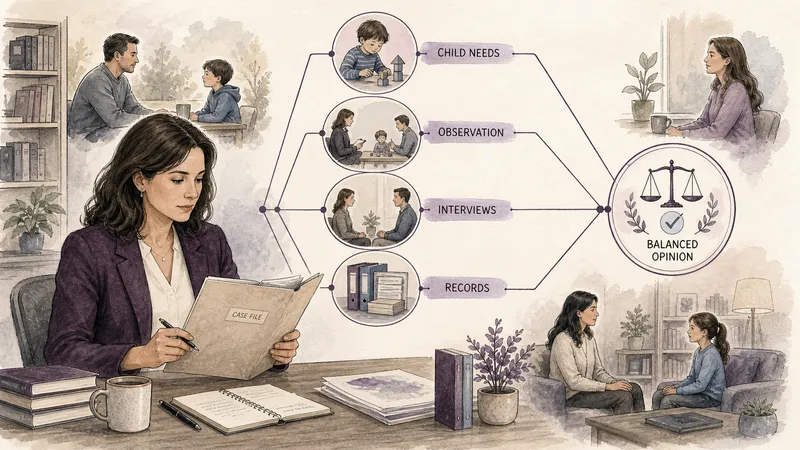
- Good evaluations use multiple methods and connect each method to the child's needs and the authorized referral.
- Testing, interviews and observations have limits. Recommendations should show the reasoning, contradictory evidence and uncertainty.
Parents may enter a custody evaluation expecting a clinical diagnosis, a character test or a quick verdict. The actual task is narrower and more demanding: gather relevant family information, evaluate competing explanations and help the court consider arrangements affecting a particular child.
Terminology differs across jurisdictions. Courts and professional bodies may use child custody evaluation, custody evaluation or parenting plan evaluation. This guide uses the terms descriptively, not as a substitute for a local court order, attorney or licensing rule.
What is a child custody evaluation?
A child custody evaluation is a forensic family assessment that gathers information about a child's needs, parenting capacities, family relationships, safety and potential parenting arrangements for use in a legal decision. Its exact scope comes from the court order, governing law and referral.
The APA Guidelines for Child Custody Evaluations in Family Law Proceedings describe a child-focused process that may use developmentally appropriate interviews, observations, psychological testing, record review and collateral interviews. The guidelines also emphasize impartiality, competence and a scope suited to the legal question.
“The evaluation should organize evidence around the child's needs and the referral, not around a search for a flawless parent.”
Forensic Psychology editorial principle
The evaluator informs the court; the court decides
The evaluator's role is different from that of a treating therapist, mediator, attorney or judge. A therapist normally works toward treatment goals and protects clinical confidentiality within its limits. A custody evaluator gathers information for a legal purpose and explains at the outset that information may be reported to the court.
| Participant | Primary role | Important boundary |
|---|---|---|
| Custody evaluator | Assesses referral-relevant family information and may offer bounded opinions. | Does not decide the legal outcome or provide therapy to the family. |
| Judge or court | Applies governing law and makes custody or parenting-plan decisions. | May accept, reject or give limited weight to an expert opinion. |
| Attorney | Provides legal advice and advocates for a client's position. | Is not a neutral evaluator of the whole family. |
| Treating clinician | Provides care based on treatment needs and a therapeutic relationship. | Usually lacks the neutral, multi-party data required for a custody opinion. |
How the custody evaluation process works
No single sequence applies everywhere, but professional guidance supports a transparent, multi-method process tied to the authorized question.
- 01
Clarify authority and scope
Review the appointment order, legal question, relevant time period, parties, deadlines, fees and limits on confidentiality.
- 02
Identify competing hypotheses
Translate allegations and concerns into questions that evidence could support, weaken or leave unresolved.
- 03
Review records
Examine relevant court, school, medical, mental-health, child-protection and communication records while considering their source and purpose.
- 04
Interview family members
Use separate, developmentally appropriate interviews to understand history, functioning, concerns and proposed arrangements.
- 05
Observe relationships when relevant
Observe parent-child interaction under defined conditions without assuming a short office sample represents all family life.
- 06
Gather collateral information
Seek information from relevant professionals or other sources and evaluate access, bias, timing and consistency.
- 07
Use testing only when it adds evidence
Select scientifically supported measures that fit the question, population, language and conditions of administration.
- 08
Integrate and communicate
Connect findings to the referral, address contradictions and alternatives, state limitations and avoid conclusions beyond the data.
What evidence does a child custody evaluator consider?
The aim is not to collect every available document. It is to obtain enough relevant, reliable and diverse information to evaluate the referral without letting one person's account control the result.
CHILD-FOCUSED EVIDENCE MAP
A 2022 comparative analysis of custody and child-maltreatment evaluation guidelines found substantial variation across countries, while recurring criteria included child development and needs, safety, family relationships, parenting abilities, conflict, risk factors and resources. The authors called for more transparent, evidence-based methods rather than formulaic recommendations.
How children may be involved
Children may be interviewed, observed with caregivers or assessed through other developmentally appropriate methods when the referral and child's circumstances support it. The evaluator should explain the purpose in language the child can understand and avoid creating the impression that the child must choose a parent.
Development affects language, memory, suggestibility, emotional expression and the meaning of a stated preference. A child's view can be relevant, but its interpretation depends on age, maturity, context, consistency and the possibility of loyalty conflict or pressure. This is one reason family-law assessment requires both forensic and developmental competence.
Custody evaluation is also distinct from a specialized juvenile forensic evaluation in delinquency or competence proceedings. The legal questions, sources and decision standards differ.
What psychological testing can and cannot add
Psychological tests do not identify the “better parent” or produce a custody answer. Properly selected measures can help examine personality functioning, symptoms, cognitive questions, response style or parenting-related constructs, but interpretation must remain connected to the referral and other evidence.
Otto, Edens and Barcus reviewed testing in custody evaluations and warned that some custody-specific instruments did not satisfy basic professional standards. They recommended examining a measure's reliability, validity, legal relevance and response-style evidence before use. Later professional guidance likewise treats testing as one part of a broader forensic assessment.
| Possible contribution | What the result cannot establish alone |
|---|---|
| Structured information about symptoms or personality functioning | Parenting quality, legal fitness or the best parenting arrangement. |
| Evidence about response style and interpretability | Motive, dishonesty in every domain or the truth of a disputed event. |
| Developmental or cognitive information relevant to a defined concern | A complete account of functioning across homes, school and time. |
| A hypothesis to compare with records, interviews and behavior | A recommendation disconnected from the child's individual needs. |
Safety concerns and intimate partner violence require focused methods
Allegations involving family violence, coercive control, child maltreatment, substance use or acute mental-health risk change the information required and the precautions needed. They should not be reduced to a generic “high-conflict” label.
The AFCC practice guidance includes a specific supplement for examining intimate partner violence in custody evaluations. Safety planning, informed procedures, careful collateral review and attention to patterns of control may be necessary. The evaluator should distinguish substantiated facts, allegations, conflicting evidence and areas that cannot be resolved.
What a custody evaluation report should communicate
A useful report makes its reasoning inspectable. It identifies the referral, methods, information considered, relevant findings, competing explanations, limitations and the connection between evidence and any opinion.
A careful report should make clear:
- who authorized the evaluation and what questions were asked;
- who participated, which records and collateral sources were considered, and what could not be obtained;
- which statements are reported allegations, observed facts, test findings or professional inferences;
- how child needs and parenting capacities connect to proposed arrangements;
- what contradictory evidence and reasonable alternatives were considered;
- whether recommendations exceed the evaluator's data or authorized scope; and
- which jurisdiction-specific decisions remain for the court.
Limits, bias and questions that test evaluation quality
Custody evaluation is a high-stakes inference task conducted with incomplete information. Family members may present incompatible accounts, records may be missing and observed behavior can change under scrutiny. Professional neutrality does not mean pretending all claims are equally supported; it means applying the same evidence standards and explaining why information receives different weight.
| Quality question | Why it matters |
|---|---|
| Was the scope clear? | Unclear authority encourages irrelevant data collection and opinions beyond the referral. |
| Were major participants and sources included? | One-sided information can produce one-sided conclusions. |
| Were methods appropriate? | Interviews, observations and tests must fit the population, language and question. |
| Were alternatives examined? | The same behavior can have multiple developmental, clinical, situational or relational explanations. |
| Does each recommendation follow from evidence? | A confident recommendation is not stronger than the reasoning that supports it. |
How to prepare without trying to perform
The safest preparation is administrative and honest: read the order, understand the evaluator's role, gather requested records, disclose relevant history, attend on time and ask procedural questions when instructions are unclear. Keep the child's needs at the center rather than treating each question as a point to win.
Rehearsing answers, coaching a child, hiding records or studying how to manipulate psychological tests can undermine the evaluation and expose the family to additional scrutiny. This page provides education, not legal advice; questions about rights, objections, evidence or local procedure belong with a qualified attorney in the relevant jurisdiction.
COMMON QUESTIONS
Child custody evaluation FAQs
What is a child custody evaluation?
A child custody evaluation is a court-related assessment intended to provide information about a child's needs, parenting capacities, family relationships, safety concerns and possible parenting arrangements. The evaluator gathers multiple sources of information and offers a bounded professional opinion; the court makes the legal decision.
Who performs a child custody evaluation?
Qualifications vary by jurisdiction and court rule. Evaluators are commonly psychologists or other qualified mental health professionals with relevant forensic, family-law, child-development and assessment training. Readers should verify the appointing order, local requirements and the evaluator's credentials.
What happens during a custody evaluation?
The process may include review of the court order and records, interviews with each parent and child, collateral interviews, observation of parent-child interactions and appropriately selected psychological measures. Scope varies with the referral, jurisdiction and family circumstances.
Does a custody evaluator decide who gets custody?
No. The evaluator may offer opinions or recommendations within the authorized scope, but the judge or other legal decision maker determines custody and parenting arrangements under applicable law.
Are psychological tests always used in custody evaluations?
No. Testing is one possible source of data. When used, a measure should be relevant to the legal question, scientifically supported for its intended purpose and interpreted with interviews, observations, records and collateral information. A test score should not decide custody by itself.
Can a parent prepare for a child custody evaluation?
A parent can read the appointment order, organize accurate records, attend on time, answer honestly and keep the child's needs central. Coaching a child, rehearsing ideal answers or trying to manage test results can reduce the quality of the information available.
How long does a child custody evaluation take?
There is no universal timeline. Duration depends on the scope, number of family members, records and collateral sources, safety issues, scheduling, jurisdictional requirements and whether additional information is needed.
How much does a child custody evaluation cost?
There is no reliable national price. Cost varies by evaluator, location, scope, family size, testing, collateral work, record volume, travel and testimony. The court order or evaluator's written agreement should explain fees, retainers and allocation of costs.
Sources and evidence base
This guide prioritizes professional guidelines, peer-reviewed reviews and published research. Local law, terminology and evaluator qualifications vary by jurisdiction.
- American Psychological Association. (2022). Guidelines for Child Custody Evaluations in Family Law Proceedings.
Current professional guidance on competence, impartiality, scope, child-focused methods, interpretation and communication.
- Association of Family and Conciliation Courts. (2006). Model Standards of Practice for Child Custody Evaluation.
Interdisciplinary model standards covering roles, process, data gathering, safety and reporting; the document notes that standards do not have the force of law unless adopted.
- Bernet, W., et al. (2022). International perspective on guidelines and policies for child custody and child maltreatment risk evaluations.
Peer-reviewed comparative analysis highlighting common assessment domains, international variation and the need for transparent evidence-based methods.
- Otto, R. K., Edens, J. F., & Barcus, E. H. (2000). The use of psychological testing in child custody evaluations.
Peer-reviewed review of test selection, legal relevance, reliability, validity and the limits of custody-specific instruments.
- Lee, S. J., et al. (2020). Custody evaluation process and report writing.
Published review of role definition, informed procedures, records, interviews, observations, testing and report structure.
- Bow, J. N., Gould, J. W., Flens, J. R., & Greenhut, D. (2006). Testing in child custody evaluations: Selection, usage, and Daubert admissibility.
Survey of psychologists examining testing purposes, selection criteria and legal admissibility concerns.
- Brandt, R., Dawes, A., Africa, A., & Swartz, L. (2004). A thematic content analysis of psychologists' reports in child custody evaluations.
Empirical analysis of custody reports identifying child needs and development as central decision domains.
- Association of Family and Conciliation Courts. Practice Guidelines and Standards.
Official source for parenting-plan evaluation guidance and the intimate-partner-violence supplement.

ABOUT THE AUTHOR
Hassam Shabbir
Hassam Shabbir is a New York-licensed psychologist and forensic psychology writer. Full license details are withheld from public display for privacy and security; legitimate professional verification requests may be submitted through the contact page.
Review author backgroundFOLLOW THE EVIDENCE