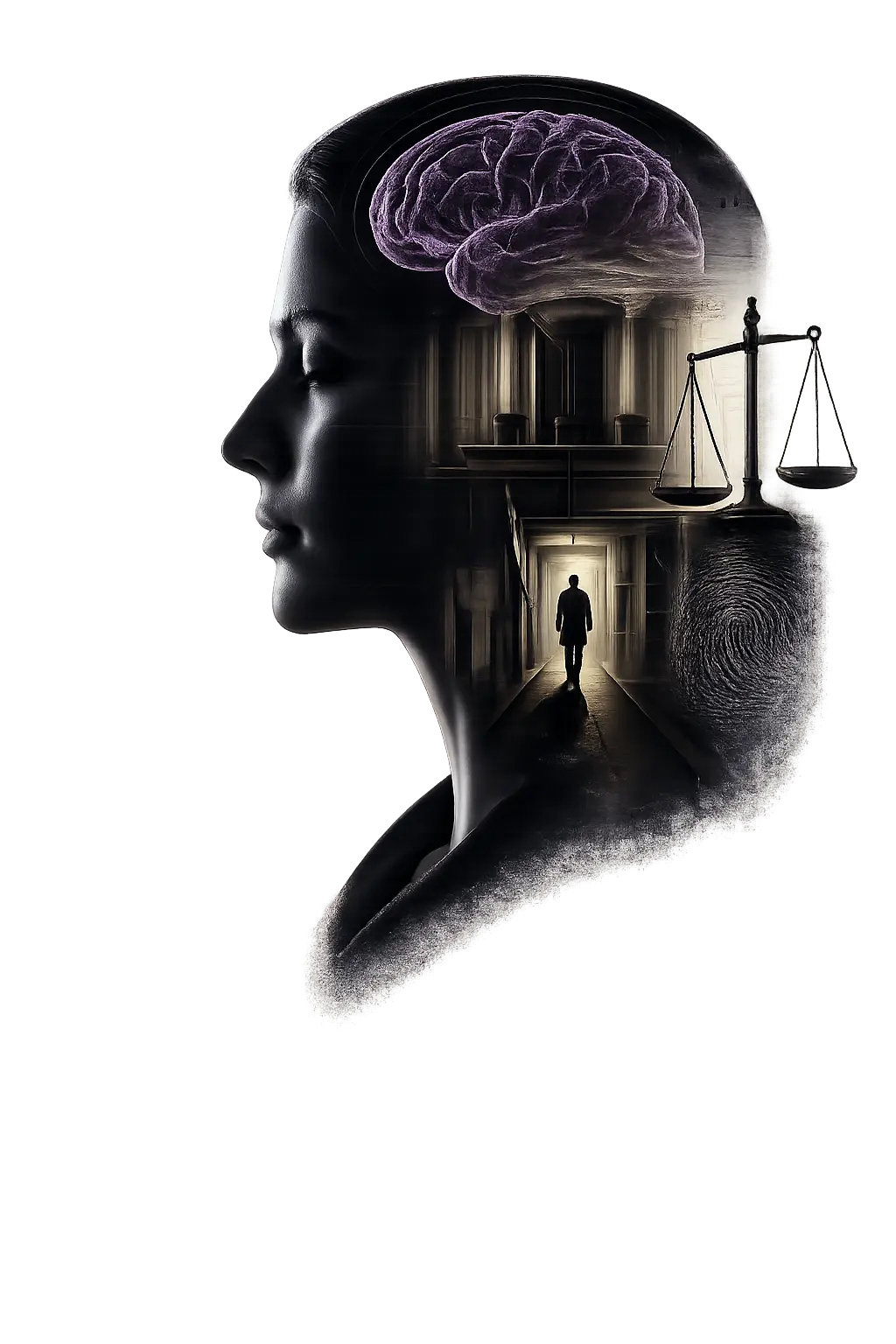
An Eyewitness Can Be Honest and Still Be Wrong
Memory is not a recording. Each retelling rebuilds the scene, shaped by attention, stress, later information and the questions asked.
Read the articlePsychology · Law · Human Behavior
When questions about memory, risk, responsibility or mental health enter a legal setting, forensic psychology brings evidence to the room. It helps people ask better questions about human behavior without pretending that certainty is easy.
Begin with the field, then follow the path that matches your question: study, careers, assessment or ethical practice.
Find your footing
Whether you are choosing a degree or trying to understand a courtroom term, start with the guide that answers the question in front of you.
See what changes when psychology leaves the clinic and enters courts, corrections and legal decision-making.
Read guideMeet the people behind the reports, evaluations, treatment plans and expert testimony.
Read guideLearn why careful listening, sound research and ethical judgment matter as much as clinical knowledge.
Read guideMatch bachelor's, master's and doctoral study to the kind of work you hope to do.
Read guideUnderstand where professionals work, what shapes pay and how opportunity differs by role.
Read guideFollow the records, interviews, assessments and consultations that shape a typical case.
Read guideThe field explained
A court may ask a narrow question: Can this person understand the proceedings? What could increase the chance of future harm? How much trust can be placed in a memory? Behind each question is a life that does not fit neatly into a form.
The psychologist's task is to slow the story down. Records are compared with interviews. Assumptions are tested against other explanations. Findings are written clearly, including what the evidence cannot establish. The goal is not to decide guilt or innocence, but to help a legal decision rest on better psychological reasoning.
See how the work is doneExplore further
Headlines reward a confident answer. Psychology asks what the evidence supports, what it leaves uncertain and why the difference matters.
Education & careers
There is no single degree that leads to every forensic psychology role. The right route depends on the work you want to do, the population you hope to serve and the licensing rules where you plan to practice.
Compare all degree pathwaysBegin with psychology, research methods and human behavior. This is where curiosity becomes a disciplined way of asking questions.
Explore bachelor's pathwaysChoose advanced training around the work itself, whether that means research, assessment, treatment or licensed practice.
Compare graduate programsTurn academic knowledge into accountable practice through supervised experience, examinations and local requirements.
Review career requirementsA more careful way to read behavior
Human behavior invites a quick story. A symptom becomes a motive, a diagnosis becomes a verdict, and a risk score begins to sound like a promise. Good forensic thinking interrupts that rush.
It compares explanations, looks for what does not fit and names the limits of the available evidence. The aim is not to drain the humanity from a case. It is to protect that humanity from conclusions that arrive too soon.
From the journal
The best articles do not rush to an answer. They show how a conclusion is built, where it can fail and what changes when a real person enters the picture.
Browse all articlesMemory is not a recording. Each retelling rebuilds the scene, shaped by attention, stress, later information and the questions asked.
Read the articleA structured score can organize evidence. It cannot remove uncertainty or replace professional judgment.
Read the articleThe interview is only one part of the work. Records, context and competing explanations complete the picture.
Read the articleClear forensic writing shows the reasoning, the evidence and the limits without hiding behind technical language.
Read the articleCommon questions
Forensic psychology is often introduced through courtroom drama. These answers offer a more useful place to begin.
They apply psychological knowledge to a specific legal question. Depending on the role, the work may include reviewing records, interviewing people, using psychological tests, assessing treatment needs, consulting with legal teams, researching justice settings or explaining findings in court.
No. Guilt is a legal decision for a judge or jury. A forensic psychologist may offer an opinion on a defined psychological issue, but that opinion must stay within the evidence, the referral question and the limits of professional expertise.
Not for most professionals. Daily work is more likely to involve competency, risk, trauma, family matters, correctional treatment, research or consultation. Profiling is a small and often overstated part of the wider field.
The answer depends on the role and the rules where you plan to work. A bachelor's degree can build the foundation, while independent assessment or licensed practice usually requires graduate training, supervised experience and professional licensure.
Not exactly. Forensic psychology is the broader application of psychology to law and legal systems. Criminal psychology usually refers more narrowly to offending behavior, although the term is used differently across media, universities and workplaces.
Keep exploring
Forensic psychology rarely offers the simplicity of a television verdict. What it offers is more useful: a disciplined way to examine evidence, context and the person behind the case.