

KEY TAKEAWAYS
- A criminal responsibility evaluation examines mental condition at the time of an alleged offense, not the defendant's ability to participate in court now.
- The evaluator reconstructs a past state using interviews, contemporaneous records, collateral accounts and behavior before, during and after the event.
- A diagnosis or test score cannot establish legal insanity. The evidence must fit the jurisdiction's exact legal standard.
- The psychologist or psychiatrist explains an opinion and its limits. The judge or jury makes the legal decision.
A criminal responsibility evaluation is a retrospective forensic assessment of a defendant's mental condition at the time of an alleged offense. It asks whether the evidence supports a qualifying mental condition, how that condition affected legally relevant capacities and whether the relationship fits the governing law.
The evaluation does not decide whether the alleged act occurred. It does not excuse conduct simply because a diagnosis is present. Its job is narrower: reconstruct the past carefully enough to help the court examine one defined psycholegal question. Compare the shared methods in our forensic assessment hub, then see how those methods apply to the insanity defense.
What does a criminal responsibility evaluation ask?
The precise question depends on the jurisdiction. In a federal insanity-defense case, 18 U.S.C. § 17 focuses on whether a severe mental disease or defect left the defendant unable to appreciate the nature and quality or wrongfulness of the acts.
State formulations can differ in language, included capacities, exclusions, verdicts and burden of proof. Some jurisdictions use a traditional insanity test, some use a modified test and some do not recognize a conventional affirmative insanity defense.
The evaluator therefore cannot begin with a generic clinical question. The first task is to identify the exact legal test, relevant time period and permitted scope of opinion.
“The diagnosis names a condition. The evaluation must explain what the evidence shows that condition meant at the legally relevant moment.”
Forensic Psychology editorial principle
Criminal responsibility is not competency to stand trial
Competency examines present participation; criminal responsibility examines past mental condition. Confusing the questions can lead the reader to apply current symptoms, functioning or test performance to the wrong point in time.
| Question | Time focus | Central issue |
|---|---|---|
| Competency to stand trial | Now | Can the defendant understand proceedings and assist counsel? |
| Criminal responsibility | Time of the alleged offense | Did mental condition meet the jurisdiction's responsibility or insanity test? |
| Mens rea | Time of the alleged offense | Did the prosecution prove the mental element required for the charged offense? |
| Treatment need | Present and future | What care may address symptoms, functioning or safety? |
Mens rea, diminished capacity and insanity are also not interchangeable. Clark v. Arizona illustrates how a jurisdiction may regulate whether and how expert mental-condition evidence can be used on these distinct issues.
A defendant can be competent now and still raise a responsibility defense about an earlier period. A defendant can also be incompetent now without having satisfied a criminal-responsibility standard at the time of the alleged conduct.
Why the legal standard must come before the diagnosis
Clinical diagnosis and legal responsibility answer different questions. A diagnostic manual helps classify mental disorders. A statute or controlling decision defines the capacities and exclusions that matter to the court.
The evaluator needs the charging information, relevant statute, court order and guidance from retaining counsel about the governing legal issue. The evaluator should understand the law without offering legal advice or replacing the court's interpretation.
Federal procedure provides one example, not a nationwide template. After required notice, 18 U.S.C. § 4242 permits a court-ordered psychiatric or psychological examination on the government's motion.
A familiar phrase such as insanity evaluation can conceal important differences. Current local law should determine the referral, evidence boundaries, report language and ultimate issue.
How a criminal responsibility evaluation works
A sound evaluation moves from legal question to evidence, reconstruction and reasoned opinion. The order prevents a diagnosis or dramatic fact from becoming the conclusion before alternatives are tested.
- 01
Define the referral
Identify the jurisdiction, legal standard, alleged conduct, relevant dates, retaining party and permitted scope.
- 02
Explain the forensic role
Describe the purpose, who will receive the findings and the limits of confidentiality before substantive questioning.
- 03
Build the evidence timeline
Collect records and observations from before, during and after the alleged offense, with special weight given to contemporaneous evidence.
- 04
Conduct the forensic interview
Ask about symptoms, thinking, perception, motivation, memory and behavior while testing the account against other information.
- 05
Use assessment methods selectively
Choose tests only when they answer a relevant diagnostic, cognitive or response-style question and interpret them within their limits.
- 06
Test competing explanations
Consider substance effects, medical conditions, memory limits, strategic presentation and explanations that do not depend on a mental disorder.
- 07
Connect evidence to the legal test
Explain which findings support or weaken each required legal element and where the available evidence remains uncertain.
Evidence before, during and after the alleged offense
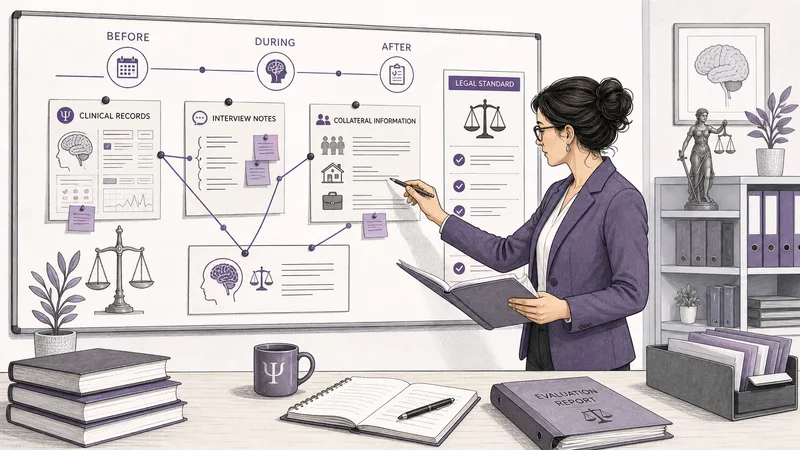
Criminal responsibility is a reconstructive question. The current interview may occur months or years later, so the evaluator needs evidence produced closer to the relevant time.
RETROSPECTIVE EVIDENCE MAP
Potential sources include emergency and treatment records, police reports, witness statements, communications, video, workplace or school records and interviews with people who observed the person near the relevant period. The proper set depends on the case and law.
Later recollection can be affected by time, repeated discussion, records reviewed since the event and the legal context. The evaluator should separate contemporaneous evidence from later reconstruction and explain discrepancies rather than silently choosing one account.
Why diagnosis does not equal legal insanity
A mental disorder may be necessary under a legal test, but it is rarely sufficient by itself. The evaluation must examine severity, timing and the functional relationship between symptoms and the alleged conduct.
Two people with the same diagnosis can have different symptoms, capacities and behavior. A person may have active symptoms yet still appreciate the nature or wrongfulness of an act under a particular standard.
The reverse shortcut is also unsafe. Organized behavior does not automatically disprove a severe mental disorder, just as unusual behavior does not prove one. The evaluator examines the full pattern and realistic alternatives.
Substance use, neurological conditions, developmental limitations and medication effects may also require examination. Their legal significance depends on the jurisdiction and cannot be inferred from a clinical label alone.
Interviews, testing and response style
The forensic interview seeks the defendant's account of the period before, during and after the alleged offense. Questions may cover symptoms, memory, perception, beliefs, goals, relationships, substance use and behavior linked to the legal standard.
Psychological testing may help examine diagnosis, cognition, personality features or response style. No instrument can travel back in time, determine whether an act occurred or apply the legal test without a broader evidentiary analysis.
Possible exaggeration, minimization and inconsistent effort should be considered with structured methods and alternative explanations. Trauma, psychosis, cognitive impairment, language, education, fatigue and misunderstanding can also produce unusual responses.
A careful evaluator neither accepts every statement at face value nor assumes deception from one inconsistency. The opinion should show how self-report, testing, collateral evidence and documented behavior converge or conflict. Read the dedicated guide to malingering assessment and validity evidence for the distinction between an invalid result and a conclusion about intent.
What the report should explain
The report should allow the reader to trace the opinion from the referral and legal standard to the evidence and reasoning. It should distinguish facts, reported information, test findings, inferences and ultimate conclusions.
Typical elements include the referral source, notification of rights and limits, sources reviewed, relevant history, account of the alleged conduct, mental-state reconstruction, assessment findings, alternative explanations and opinion.
Important missing records, conflicting accounts and limits should remain visible. If the available information does not support a reliable opinion, the evaluator should say so and identify what additional evidence could matter.
The judge or jury makes the legal decision. The evaluator should follow the jurisdiction's rules about ultimate-issue language and avoid opinions about guilt, witness credibility or legal questions outside the referral.
Limits, bias and uncertainty
Retrospective evaluation can never directly observe the past mental state. Records may be incomplete, witnesses may disagree and later interviews may reflect memory change or litigation concerns.
A dramatic allegation can create contextual bias. A severe diagnosis can produce diagnostic overshadowing, while apparently purposeful behavior can cause an evaluator to discount evidence that does not fit an early theory.
Bias safeguards include defining the legal question first, seeking disconfirming evidence, separating observation from inference and documenting why competing explanations were accepted or rejected. Our guide to ethics in forensic psychology explains the broader duties of impartiality and role clarity.
Reasonable evaluators may weigh imperfect evidence differently. A transparent report does not hide that uncertainty; it shows where it enters the reasoning and how strongly the opinion can be stated.
A hypothetical criminal responsibility example
Consider a defendant who reports believing that a stranger was an immediate supernatural threat. The current interview describes intense fear and a fixed false belief at the time of the alleged offense.
Treatment records from the prior month document similar beliefs before any criminal charge. A family member describes rapid deterioration, and emergency records shortly after the event record the same theme.
Other evidence shows planning and concealment. Those behaviors may support awareness, but their meaning is not automatic. The evaluator asks whether they reflect appreciation of wrongfulness, avoidance of perceived danger, ordinary self-protection or another explanation.
The final analysis does not announce that diagnosis equals insanity. It explains which evidence supports a qualifying condition, how symptoms related to the relevant capacities and whether the relationship fits the exact legal standard. The court then decides the legal issue.
Questions that test the quality of the evaluation
- Is the governing legal standard quoted or stated accurately?
- Is the relevant time period clearly defined?
- Were the forensic role and limits of confidentiality explained?
- Does the report distinguish competency, mens rea and criminal responsibility?
- Were contemporaneous records and collateral sources sought?
- Are later memories separated from evidence produced near the event?
- Does the evaluator connect symptoms to legally relevant capacities?
- Were substance effects, medical conditions and response style considered?
- Are competing explanations and disconfirming evidence visible?
- Do testing conclusions remain within the methods' established limits?
- Are missing information and uncertainty stated?
- Is the final legal decision left to the proper fact-finder?
Common questions about criminal responsibility evaluation
What is a criminal responsibility evaluation?
A criminal responsibility evaluation is a retrospective forensic assessment of a defendant's mental condition at the time of an alleged offense. The evaluator examines whether reliable evidence supports a mental disorder, how that condition related to the conduct and whether the relationship fits the jurisdiction's legal test. The court, not the evaluator, makes the legal decision.
Is criminal responsibility the same as competency to stand trial?
No. Competency asks whether the defendant can understand and participate in the case now. Criminal responsibility usually asks about mental condition at the time of the alleged offense. A person may be competent for trial but still raise a responsibility defense, or may be incompetent now without having met a responsibility standard earlier.
Does a mental illness mean a person was legally insane?
No. A diagnosis does not automatically satisfy an insanity standard. The evaluator must connect symptoms and functional effects to the exact legal test and the time of the alleged conduct. The definitions of mental disease or defect, the required capacities and the burden of proof vary by jurisdiction.
What evidence is used in a criminal responsibility evaluation?
The evaluator may use interviews, contemporaneous treatment and medical records, police and emergency records, witness accounts, digital or communication records, prior evaluations and behavior before, during and after the alleged offense. The relevant sources depend on the referral, governing law and available evidence.
Can one psychological test determine criminal responsibility?
No. Testing may clarify diagnosis, cognition, personality features or response style, but no score reconstructs a past mental state or applies a legal standard by itself. The opinion must integrate testing with records, interviews, collateral information and the documented behavior surrounding the alleged offense.
Who decides whether a defendant was criminally responsible?
The judge or jury applies the law and reaches the legal decision. A qualified forensic psychologist or psychiatrist may explain psychological findings and offer an opinion within the permitted scope. The fact-finder can accept, reject or give limited weight to that opinion.
Is an insanity defense available in every state?
No single rule applies across the United States. Jurisdictions define and handle mental-condition defenses differently, and some do not recognize a traditional affirmative insanity defense. Current statutes, case law and local procedure must be checked for the specific case.
Is a criminal responsibility evaluation confidential?
It is not ordinary therapy confidentiality. The evaluator should explain who requested the evaluation, who may receive the information and how statements may be used. Court orders, privilege, discovery rules and the side retaining the evaluator can affect disclosure, so the governing legal procedure matters.
Sources
Federal law, U.S. Supreme Court authority, APA-adopted forensic guidelines and peer-reviewed practice resources were selected for the legal distinctions, retrospective methods, evidence use and professional limits described here. Sources were reviewed on August 22, 2026.
- 18 U.S.C. § 17. Insanity defense.
Current federal definition, exclusions and burden of proof for the federal affirmative insanity defense.
- 18 U.S.C. § 4242. Determination of the existence of insanity at the time of the offense.
Current federal procedure for a psychiatric or psychological examination after notice of an insanity defense.
- Federal Rule of Criminal Procedure 12.2. Notice of an insanity defense; mental examination.
Federal notice, examination, disclosure and statement-use rules for mental-condition evidence.
- Janofsky, J. S., Hanson, A., Candilis, P. J., et al. (2014). AAPL practice guideline for forensic psychiatric evaluation of defendants raising the insanity defense.
Peer-reviewed professional guidance on retrospective reconstruction, collateral evidence, interviews, response style, reports and legal-standard analysis.
- Glancy, G. D., Ash, P., Bath, E. P. J., et al. (2015). AAPL practice guideline for the forensic assessment.
Professional guidance on forensic roles, consent and notification, records, collateral data, assessment methods and communication of limits.
- American Psychology-Law Society. Specialty Guidelines for Forensic Psychology.
APA-adopted guidance on competence, impartiality, informed notification, assessment and communication in forensic practice.
- Clark v. Arizona, 548 U.S. 735 (2006).
U.S. Supreme Court discussion showing that insanity formulations and the use of mental-condition evidence can differ across jurisdictions.
- Sadoff, R. L., Shill, M. A., & Hucker, S. J. (2018). Using technology to improve the objectivity of criminal responsibility evaluations.
Peer-reviewed discussion of reconstructing decision-making, behavioral control and emotional state using integrated collateral evidence.