

KEY TAKEAWAYS
- A bachelor's degree can support probation, human-service, research and analytical roles, but not independent psychologist practice.
- A master's degree may open program, research or separately licensed counseling routes, depending on the curriculum and jurisdiction.
- Licensed forensic psychologist work usually requires qualifying doctoral education, supervised experience, examinations and state licensure.
Jobs with a forensic psychology degree depend on the work you are legally and professionally prepared to do. Degree level matters, but so do your major, field placements, research skills, employer requirements and state licensing rules.
What jobs can you get with a forensic psychology degree?
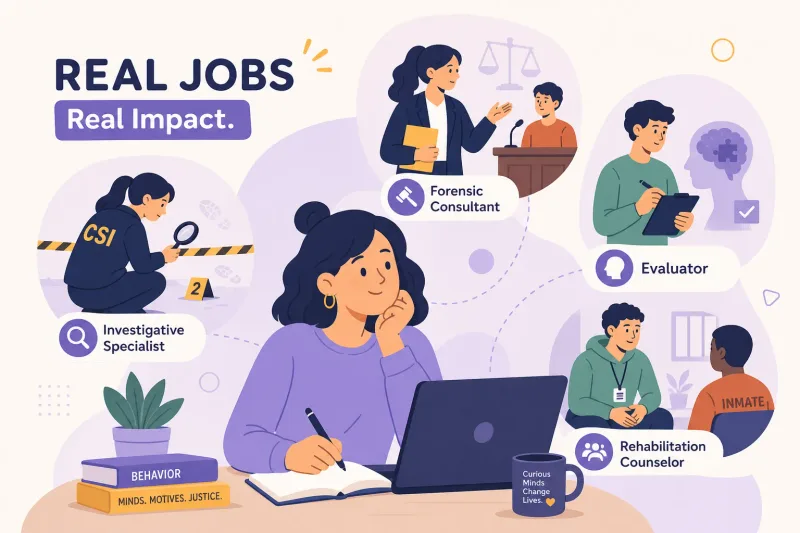
You can pursue related roles in probation, corrections, victim services, rehabilitation, research, program evaluation and crime analysis. With qualifying doctoral training and licensure, you may also pursue psychological assessment, treatment, consultation and expert work in legal settings.
There is no single labor-market category called “forensic psychology degree jobs.” Employers hire for specific occupations, and many accept more than one relevant major.
This distinction protects you from a common career mistake. A degree name may sound directly connected to a role while its curriculum does not meet the role's license, methods or experience requirements. The same rule applies when comparing criminal psychology and forensic psychology careers.
“Choose the responsibility first. Then choose the education that makes you eligible to carry it.”
Forensic Psychology career-planning principle
How does degree level change your career options?
A bachelor's degree usually supports entry or early-career roles under agency policies. A master's degree can add research, program and specialized practice options, but only when the program fits the intended credential.
A certificate is not another degree level. If you are comparing shorter credentials, review what current online forensic psychology certificate programs teach and what they do not authorize.
A doctorate becomes important when the goal is licensed psychologist practice. Most U.S. jurisdictions require a doctoral degree for independent practice, along with supervised experience and examinations.
Degree level is not the whole answer. A bachelor's graduate with strong statistics and geographic-information skills may fit an analyst vacancy better than a graduate with a more specialized title but no technical portfolio.
Open five current vacancies in your target state. Record the required degree, accepted majors, experience, license, technical skills and screening conditions before comparing programs.
Which jobs are realistic with a bachelor's degree?
Bachelor's-level opportunities usually involve public safety, case support, rehabilitation, research or data. They are related to forensic psychology, but they do not make the employee a forensic psychologist. Compare the curriculum and outcomes in the bachelor's degree guide.
Probation officer or correctional treatment specialist
These professionals supervise people in custody, probation or parole and may help develop rehabilitation plans. BLS lists a bachelor's degree as the typical entry education, while agencies may also require examinations, training and background screening.
Victim-services or human-service worker
Titles include victim advocate, case aide, residential counselor and human-service assistant. Duties can involve safety planning, referrals, service navigation and documentation.
Requirements vary widely. Some roles accept a high school diploma plus training, while more complex case positions may prefer a bachelor's degree and relevant experience.
Research assistant
Universities, courts, agencies and research organizations may hire assistants to recruit participants, code records, manage data or support literature reviews. Statistics, research design, writing and software skills often matter more than the word “forensic” in the degree title.
Crime or intelligence analyst
Analysts organize records, identify patterns, prepare briefings and support investigative decisions. O*NET reports that many intelligence-analyst roles require a four-year degree plus related experience or training.
Psychology can help with behavior and research literacy, but employers may also expect data analysis, mapping, criminal-justice knowledge or security eligibility.
Correctional officer
Correctional officers manage safety and order in institutions. BLS lists high school education as the typical entry level, although some federal or specialized positions require a bachelor's degree or qualifying experience.
This is a security role, not psychological practice. A forensic psychology degree may be relevant, but academy training and agency standards determine eligibility.
What can you do with a master's in forensic psychology?
A master's degree can strengthen eligibility for research coordination, program evaluation, policy work, senior case services and justice-program management. Employers may still require direct experience, technical skills or a different professional credential. The master's program guide shows what to verify before choosing this route.
Program coordinator or evaluator
These roles organize services, monitor outcomes, supervise projects and report whether a program is working. Useful preparation includes statistics, implementation, budgeting and clear writing.
Research coordinator or policy analyst
Research-focused graduates may manage studies, analyze policy or examine outcomes in courts, corrections and community programs. A thesis, strong methods training and a work sample can be more persuasive than specialization language alone.
Counseling or rehabilitation work
Some positions require a counselor, social-worker or other clinical license. A master's in forensic psychology does not automatically satisfy those separate education and practicum rules.
Before enrolling, ask the program to name the exact license its curriculum supports in your state. Verify the answer with the licensing board, not only the admissions page.
Which jobs require doctoral training and psychologist licensure?
Licensed psychologists may perform psychological assessment, diagnosis and treatment within their competence and jurisdiction. In forensic settings, the work may also include consultation, reports and expert testimony tied to a defined legal question. Compare PhD, PsyD and licensure alignment in the doctoral program guide.
Forensic evaluator
An evaluator may examine competence, criminal responsibility, violence risk, civil damages, disability or parenting questions. The evaluator must match methods and conclusions to the referral and evidence.
Correctional or secure-hospital psychologist
Psychologists in prisons, jails and secure hospitals may provide treatment, crisis care, assessment, program consultation and team support. The balance depends on the institution and position.
Independent consultant or expert witness
Experienced psychologists may consult with courts or attorneys and explain specialized findings. Licensure does not make every psychologist qualified for every legal issue, and testimony should remain within demonstrated competence.
Academic researcher or professor
Doctoral researchers can study legal decision-making, memory, assessment, corrections and policy. Research roles may not require clinical licensure when they do not involve independent psychology practice.
ABPP forensic board certification is an additional postdoctoral specialty credential. It does not replace the state license, and it is not required for every forensic role.
How do real forensic psychology jobs compare?
| Role | Common duties | Typical education context | Important boundary |
|---|---|---|---|
| Probation officer | Supervision, case planning, reports and referrals | Bachelor's degree is typical nationally | Agency testing and rules vary |
| Victim-services worker | Advocacy, referrals, safety support and documentation | Varies from training to bachelor's or master's preparation | Not automatically a therapist role |
| Research assistant | Data, records, recruitment and literature review | Bachelor's or master's, depending on responsibility | Methods skills often decide fit |
| Crime or intelligence analyst | Pattern analysis, briefings and investigative support | Many roles expect a bachelor's plus relevant skills | Psychology alone may not cover technical requirements |
| Program coordinator | Service delivery, outcomes, staff and reporting | Bachelor's or master's plus experience | Management is different from clinical practice |
| Licensed forensic psychologist | Assessment, treatment, consultation and testimony | Usually qualifying doctorate, supervision, exams and license | Scope depends on jurisdiction and competence |
How much do forensic psychology degree jobs pay?
Salary should be compared by occupation, not by degree title. BLS does not publish one national wage for “forensic psychologist,” so any single forensic salary figure can hide major differences.
For May 2025, BLS reported median annual pay of $73,130 for probation officers and correctional treatment specialists. It reported $47,690 for social and human service assistants and $63,630 for correctional officers and jailers.
Psychologist data cover several specialties rather than forensic psychology alone. The latest occupation-specific figures, local wages and employer pay scales should be checked when making a career decision.
Our forensic psychology salary and job outlook guide explains how occupation, sector, location and licensure change the comparison.
How should you search for jobs with this degree?
- 01
Search by duty, not only by degree
Use terms such as probation, victim services, research coordinator, program evaluator, behavioral health, crime analyst and correctional treatment.
- 02
Separate required from preferred
A vacancy may accept several majors while treating a license, clearance or technical skill as nonnegotiable.
- 03
Build evidence of ability
Use placements, research, writing samples, data projects and supervised experience to show what you can do.
- 04
Verify regulated work
Check the state board before assuming a degree supports a protected title or independent psychological service.
- 05
Compare outcomes before paying
Ask programs for completion, placement, internship and licensure data that match your intended route.
Start with our forensic psychology degree comparison, then examine the license requirements if your goal involves psychologist practice.
Common questions about forensic psychology degree jobs
What jobs can you get with a forensic psychology degree?
Possible roles include probation officer, correctional treatment specialist, social or human service assistant, victim-services worker, research assistant, program coordinator and crime or intelligence analyst. Licensed forensic psychologist roles usually require doctoral training, supervised experience, examinations and state licensure.
Can you become a forensic psychologist with a bachelor's degree?
No. A bachelor's degree can support entry into related justice, research and human-service roles, but it does not qualify someone for independent practice or the protected psychologist title. Most U.S. jurisdictions require a qualifying doctoral degree for independent psychology practice.
Is a master's in forensic psychology enough for licensure?
Usually not for independent psychologist practice. Some jurisdictions permit limited or supervised master's-level psychology practice, and separate counseling or social-work licenses require their own qualifying degrees and training. Always confirm the exact program and board rules before enrolling.
Do you need a forensic psychology degree to work in the field?
Not always. Employers may accept degrees in psychology, criminal justice, social work, counseling, statistics or another relevant field. The required major depends on the duties, employer and jurisdiction.
Can a forensic psychology degree lead to FBI work?
It may satisfy the education component for some federal vacancies, but no degree guarantees FBI employment. Federal roles have vacancy-specific requirements that can include experience, analytical skills, background screening, citizenship and other conditions.
What is the highest-paying forensic psychology job?
Licensed psychologist and senior leadership roles may pay more than entry-level support positions, but there is no reliable national wage category for forensic psychologists alone. Salary changes with occupation, license, setting, location and experience.
Is forensic psychology a good degree?
It can be useful when the curriculum, field experience and graduate outcomes match a specific career goal. It is a weak choice when selected by title alone without checking job descriptions, licensure eligibility, cost and employer demand.
Sources
Official labor and professional sources were used to separate degree possibilities from employer and licensing requirements. Sources were reviewed on August 16, 2026.
- U.S. Bureau of Labor Statistics. Field of Degree: Psychology.
Shows how broadly psychology graduates are distributed across occupations and why a degree title does not map to one job.
- U.S. Bureau of Labor Statistics. Probation Officers and Correctional Treatment Specialists.
Current national duties, typical bachelor's-level entry, work setting, pay and employment outlook for this occupation.
- U.S. Bureau of Labor Statistics. Social and Human Service Assistants.
National information on client-service work in psychology, rehabilitation and social services, including entry requirements and pay.
- U.S. Bureau of Labor Statistics. Correctional Officers and Bailiffs.
Clarifies that correctional security work has agency-specific entry and academy requirements and is distinct from psychologist practice.
- U.S. Bureau of Labor Statistics. Psychologists.
National information on psychologist education, licensure, work settings and broader occupational pay. The category is not forensic-specific.
- U.S. Bureau of Labor Statistics. National Occupational Employment and Wage Estimates, May 2025.
The most recent national wage estimates used for the three occupation examples in this article.
- O*NET OnLine. Intelligence Analysts.
Federal occupational data describing crime and intelligence analyst titles, duties, preparation and experience expectations.
- Association of State and Provincial Psychology Boards. Requirements to Practice.
Explains jurisdiction-based education, examination and supervised-experience requirements for psychology practice.
- American Board of Professional Psychology. Forensic Psychology Specialty Requirements.
Current postdoctoral experience, specialty training and examination requirements for optional forensic board certification.