

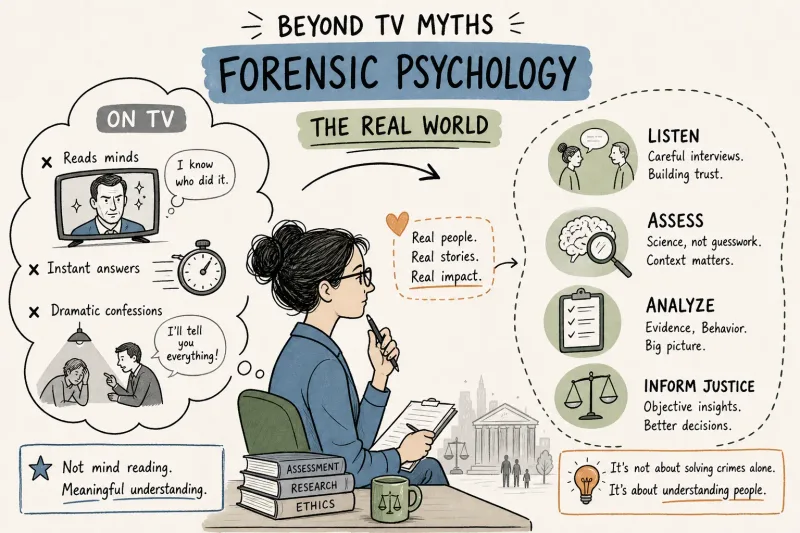
KEY TAKEAWAYS
- Forensic psychologists do not read minds, decide guilt or spend most days chasing unknown offenders.
- Real work often combines records, interviews, assessment, consultation, report writing and clearly explained uncertainty.
- The correct education route depends on the duty. Licensed evaluation, research and justice-system support are not the same career path.
Forensic psychology TV myths turn a careful specialty into instant profiling. Real forensic psychologists apply psychological knowledge to defined legal questions, then show how the evidence supports an opinion and where it stops.
What is the real world of forensic psychology?
Forensic psychology is the use of psychological science and professional expertise in legal, contractual and administrative matters. It can involve criminal cases, civil disputes, family matters, corrections, research and policy.
The APA specialty description emphasizes psychological expertise intended to assist judicial and legal systems. That is broader than criminal investigation and narrower than every job involving psychology and crime.
A referral might ask whether a defendant can participate in a trial, what treatment a correctional patient needs or how psychological findings relate to damages in a civil claim. Each question requires different evidence.
“The real skill is not sounding certain. It is making the reasoning clear enough to be examined.”
Forensic Psychology editorial principle
Which forensic psychology TV myths cause confusion?
| TV version | Real practice | Why the difference matters |
|---|---|---|
| One expert handles everything | Investigators, psychologists, attorneys, physicians and laboratory specialists have separate roles | Each conclusion must stay within the professional's competence and authority |
| Behavior reveals the answer instantly | Behavior is interpreted with records, context, collateral information and tested methods | A single cue can have many explanations |
| Profiling identifies the offender | Behavioral analysis may generate or prioritize hypotheses | A profile is not proof that a particular person committed an act |
| The psychologist decides guilt | The psychologist addresses a psychological referral question | Courts and juries make legal findings |
| Every case ends in testimony | Many cases end with consultation, treatment or a written report | The quiet work is often the main work |
What do forensic psychologists actually do?
The task begins with a referral. A clear referral identifies the decision, the legal standard, the person or system being examined and who will receive the information.
Assessment may include interviews, records, collateral contacts and psychological measures selected for the question. A responsible evaluator does not collect data simply because it is available.
Report writing connects facts, methods and inference. The report should distinguish what was observed, what another source reported and what the psychologist concludes.
Treatment is another major route. Psychologists may work in hospitals, prisons, jails or community programs while maintaining boundaries between therapeutic and evaluative roles.
What can a realistic forensic psychology workday look like?
- 01
Review the referral and records
The psychologist identifies the legal question and reads relevant medical, educational, correctional or court information.
- 02
Interview with purpose
Questions test competing explanations and give the person a fair opportunity to provide context.
- 03
Use appropriate methods
Tests and structured tools are chosen for their fit, evidence and limits rather than their dramatic appeal.
- 04
Integrate the evidence
The psychologist checks consistency, alternatives, missing information and the strength of each inference.
- 05
Write or consult
The final product may be a report, treatment plan, case consultation, research finding or testimony.
Our day-in-the-life guide follows these tasks in more detail and explains why writing and preparation occupy so much time.
Where does real forensic psychology happen?
Work may occur in courts, government agencies, correctional facilities, secure hospitals, community programs, universities and private practice. The setting does not by itself define the role.
A hospital psychologist may treat a patient, evaluate competence or consult with a team. Those activities carry different goals, relationships and confidentiality limits.
National BLS data describe psychologists across all specialties, so they should not be treated as a forensic-only job count. The data do confirm that psychologists work across healthcare, schools, government and self-employment.
Is criminal profiling a typical forensic psychology job?
No. Criminal profiling is a narrow activity, not the typical daily job of most forensic psychologists. Television gives it unusual visibility because the story is easy to dramatize.
The review by Snook and colleagues found limited evidence that self-identified profilers or experienced investigators consistently outperformed comparison groups. That does not mean every behavioral analysis is useless. It means claims should match the quality of the method and evidence.
Our complete criminal profiling guide separates investigative hypotheses from case proof. The criminal psychology vs forensic psychology guide explains why neither field is defined by profiling.
What does an expert witness really do?
An expert witness helps the court understand specialized information. The expert does not become an advocate for whichever side requested the work.
Direct examination presents the opinion and its basis. Cross-examination tests assumptions, methods, missing evidence and alternative explanations.
A useful answer can include “I do not know” or “the available evidence cannot support that conclusion.” Clear limits strengthen an opinion because they show where professional knowledge ends.
What education does real forensic practice require?
Independent practice as a psychologist generally requires doctoral preparation, supervised experience, examinations and licensure in the relevant jurisdiction. Exact requirements vary by state and position.
Forensic specialization can develop through practica, internship, postdoctoral work, supervision, continuing education and direct experience. ABPP board certification is an additional specialty credential, not the basic license to practice psychology.
Related roles can follow different routes. Researchers, victim-service specialists and justice-program professionals may not need psychologist licensure when their duties do not involve independent psychology practice.
Compare the full pathway to becoming a forensic psychologist before selecting a degree by title alone. Then use the forensic psychology certification guide to distinguish an academic certificate, a state license and ABPP board certification.
How can you test whether this career fits you?
Start with the ordinary Tuesday, not the most dramatic courtroom moment. Ask whether you enjoy detailed reading, structured interviewing, careful writing and having your reasoning questioned.
Then identify the duty you want to perform. Assessment, treatment, research and justice support lead to different education and licensing decisions.
Read several real job descriptions in your target state. Compare their duties with the forensic psychology career paths, then work backward to the required credential.
Common questions about forensic psychology TV myths
Is forensic psychology like it appears on TV?
Usually not. Television often compresses assessment, investigation, consultation and testimony into one dramatic role. Real forensic psychology centers on a defined legal question, careful records, interviews, appropriate methods, written reasoning and clearly stated limits.
Do forensic psychologists solve crimes?
Forensic psychologists may support legal or investigative decisions, but they do not usually solve crimes. Their work can include evaluation, treatment, consultation, research and testimony. Police, attorneys, judges and other professionals hold different responsibilities.
Are most forensic psychologists criminal profilers?
No. Criminal profiling is a narrow activity and is not the typical job of most forensic psychologists. Many work on competency, risk, disability, family, correctional treatment, civil litigation, research or policy questions.
Can a forensic psychologist tell whether someone is lying?
No interview, test or behavioral cue provides a perfect lie detector. A psychologist can examine consistency, context, response patterns and relevant evidence, but should not present certainty that the method cannot support.
Do forensic psychologists decide guilt or innocence?
No. Guilt and innocence are legal decisions for courts and juries. A psychologist addresses the psychological question within the referral and explains the evidence and limits of the opinion.
What does a forensic psychologist do every day?
A day may include reading records, interviewing a person, consulting with attorneys or treatment teams, scoring assessment measures, researching a legal standard and writing a report. Court testimony is important in some roles but does not fill every day.
What degree is needed for forensic psychology?
Independent practice as a psychologist generally requires doctoral training, supervised experience, examinations and state licensure. Research, victim services, probation support and other related roles may follow different degree and credential routes.
Sources
Professional guidance, career data and peer-reviewed research were selected to compare entertainment with real practice. Sources were reviewed on August 15, 2026.
- American Psychological Association. Forensic Psychology.
Defines the specialty as psychological expertise intended for judicial and legal systems and describes its civil and criminal scope.
- American Psychology-Law Society. Specialty Guidelines for Forensic Psychology.
Professional guidance on competence, role clarity, methods, assessment, privacy and communication in legal contexts.
- Snook, B., Eastwood, J., Gendreau, P., Goggin, C., & Cullen, R. M. (2007). Taking Stock of Criminal Profiling.
Two meta-analyses found limited evidence that profiler or experienced-investigator groups consistently outperform comparison groups.
- Shelton, D. E. (2008). The CSI Effect: Does It Really Exist? National Institute of Justice.
Reports that crime-show viewers expected more scientific evidence, while viewing had little or no effect on willingness to convict in the study.
- American Board of Professional Psychology. Forensic Psychology Specialty Requirements.
Current specialty certification requirements, including doctoral preparation, postdoctoral specialty training and forensic experience.
- U.S. Bureau of Labor Statistics. Psychologists, Occupational Outlook Handbook.
National information on psychologist duties, work settings, education, licensure and employment. The category is broader than forensic psychology.