
KEY TAKEAWAYS
- Forensic psychology applies psychological science and professional expertise to legal questions involving people, behavior and mental functioning.
- Forensic science analyzes physical or digital evidence using methods from disciplines such as biology, chemistry, toxicology and digital forensics.
- The degrees are not interchangeable. Choose by the evidence and daily work you want, then verify the program against the relevant employer, accreditation and licensing requirements.
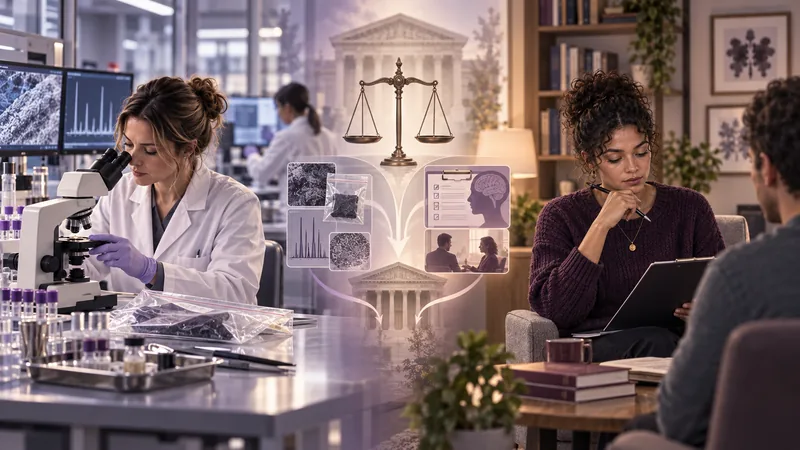
The simplest difference is the evidence: forensic psychologists evaluate psychological questions about people, while forensic scientists examine physical or digital material. Television often combines both roles into one investigator. Real cases divide responsibilities among trained professionals whose methods, credentials and conclusions must remain within their competence.
What is the difference between forensic psychology and forensic science?
Forensic psychology is a specialty in professional psychology. The American Psychological Association describes it as psychological expertise provided within judicial and legal systems. Work may address competency, criminal responsibility, risk, damages, treatment needs, custody or another defined psycholegal question.
Forensic science applies scientific methods to evidence that may be used in an investigation or legal proceeding. Depending on the discipline, the evidence may include DNA, controlled substances, toxicology samples, fingerprints, firearms evidence, documents, digital data or trace material.
The word forensic means connected with law or legal decision-making. It does not turn every forensic occupation into psychology, crime-scene investigation or police work.
Forensic psychology vs forensic science: side-by-side
| Question | Forensic psychology | Forensic science |
|---|---|---|
| Primary subject | Behavior, mental functioning and psychological questions relevant to law | Physical, biological, chemical, pattern or digital evidence |
| Typical methods | Records, interviews, psychological measures, observation, collateral information and research | Collection, preservation, microscopy, instrumentation, comparison, validation and laboratory analysis |
| Common output | Psychological report, consultation, treatment plan, research finding or expert opinion | Laboratory report, analytical result, comparison, scene documentation or expert explanation |
| Education foundation | Psychology, assessment, research methods, ethics and law | Natural science, mathematics, laboratory methods, quality assurance and evidence handling |
| Regulation | Psychologist practice and title are regulated by state law; requirements vary | Requirements depend on discipline, laboratory, employer, jurisdiction and any applicable accreditation or certification |
| Common settings | Courts, clinics, hospitals, corrections, government, universities and private practice | Crime laboratories, medical examiner systems, law-enforcement agencies, government laboratories and evidence units |
| Main boundary | Does not determine guilt or replace the legal decision maker | Does not reconstruct a person's motives or psychological state from laboratory evidence alone |
What does a forensic psychologist do?
A forensic psychologist starts with a psychological question that matters to a legal or administrative decision. The evaluator may review records, conduct interviews, select relevant psychological measures, obtain collateral information and explain how the evidence supports or limits an opinion.
Other forensic psychologists provide treatment, consultation, research, program evaluation or testimony. The purpose and role matter. Working in a prison, court or police agency does not automatically make every activity a forensic psychological service.
Use the field guide to forensic psychology for the full scope, or compare the forensic assessment process when the work involves an evaluation.
What does a forensic scientist do?
The Bureau of Labor Statistics describes forensic science technicians as workers who collect and analyze evidence. Some work at scenes, where they document and preserve material. Others work mainly in laboratories, where they perform tests, operate instruments, follow quality procedures and prepare reports.
Forensic science is not one method. DNA analysis, toxicology, seized-drug analysis, digital evidence, firearms examination and trace evidence require different scientific preparation and standards. NIST's OSAC Registry organizes reviewed standards intended to improve valid, reliable and reproducible forensic results across disciplines.
A crime-scene technician, forensic chemist, DNA analyst and digital forensic examiner do not share one universal curriculum. Read the current vacancy and the laboratory's discipline-specific requirements before choosing a degree.
Which degrees and training routes lead to each field?
Forensic psychology route
A bachelor's or master's program may support research, justice services or preparation for further study, but it does not automatically authorize psychologist practice. Independent clinical and forensic psychologist roles generally require a license-eligible doctoral route, supervised experience, examinations and state licensure.
Program names are not enough. Verify accreditation, internship access and the rules of the state where you plan to practice. The forensic psychology degree guide separates bachelor's, master's and doctoral outcomes.
Forensic science route
BLS lists a bachelor's degree as the typical entry education for forensic science technicians. Relevant majors may include forensic science, biology, chemistry or another natural science, depending on the laboratory and discipline. Employers may require specific coursework, competency testing, supervised training or quality-system experience.
The American Academy of Forensic Sciences' FEPAC accredits eligible forensic science education programs under defined standards. FEPAC accreditation is relevant to forensic science programs; it is not psychology licensure or APA accreditation.
How do careers and workplaces differ?
| Forensic psychology examples | Forensic science examples |
|---|---|
| Licensed forensic psychologist | Forensic science technician |
| Correctional or public-service psychologist | DNA or forensic biology analyst |
| Psychology-law researcher | Forensic chemist or toxicology analyst |
| Forensic treatment or assessment professional | Crime-scene or evidence technician |
| Psychological consultant or expert witness | Digital forensic examiner |
These are examples, not automatic outcomes from a degree title. A graduate should compare the exact duties, minimum education, license or certification, security requirements and training period in current vacancies.
If your interest is mainly in people, reports and legal questions, explore forensic psychology career paths. If it is mainly in specimens, instruments and laboratory quality, inspect forensic science curricula and public-laboratory job descriptions.
How do salary and job outlook compare?
A clean national salary comparison is not available. BLS publishes an occupation profile for forensic science technicians, but it does not publish a dedicated forensic psychologist category. Forensic psychologists may appear within broader psychologist categories, which also contain professionals doing other work.
The current BLS forensic science technician profile reports a May 2024 median annual wage of $67,440 and projected employment growth of 13% from 2024 to 2034. Those figures describe the federal occupation, not every forensic scientist, laboratory discipline or job offer.
For psychology, compare the actual vacancy with the most appropriate psychologist category, state wage data and employer salary schedule. The forensic psychology salary guide explains why one internet average cannot represent every forensic role.
Which field fits your interests and strengths?
| If you prefer | Explore first |
|---|---|
| Interviews, psychological assessment, behavior, research and extended report writing | Forensic psychology |
| Laboratory science, instruments, specimens, measurement and quality control | Forensic science |
| Helping courts understand mental functioning or behavior | Forensic psychology |
| Identifying and explaining physical or digital evidence | Forensic science |
| Possible doctoral training and regulated psychologist practice | Forensic psychology |
| A science bachelor's route into discipline-specific laboratory training | Forensic science |
Before applying, compare required courses and daily duties. A dramatic interest in crime is too broad to select either field. The useful question is whether you want to build conclusions primarily from psychological information about people or from scientific analysis of material evidence.
This guide provides general U.S.-focused education. It does not determine admission, employment, licensure, certification or individual career fit. Current programs, employers, accreditation bodies and state authorities control their requirements.
Common questions about forensic psychology and forensic science
What is the main difference between forensic psychology and forensic science?
Forensic psychology applies psychological knowledge to legal, contractual and administrative questions involving people, behavior and mental functioning. Forensic science applies scientific methods to physical or digital evidence. The fields may contribute to the same case, but they use different evidence, training and professional standards.
Does a forensic psychologist work in a crime lab?
Crime-laboratory analysis is generally forensic science work rather than forensic psychology. A forensic psychologist is more likely to review records, interview people, use psychological assessment methods, conduct research, provide treatment or consultation, write reports and testify about psychological questions.
Does a forensic scientist interview suspects?
A forensic scientist may communicate with investigators, attorneys and other professionals, but analyzing suspects' motives or mental condition is not the defining forensic science role. Typical work centers on identifying, testing, documenting and explaining physical or digital evidence within the scientist's discipline.
Can a forensic science degree make someone a forensic psychologist?
No. A forensic science degree does not replace the psychology education, supervised experience, examinations and state licensure required for psychologist practice. A person changing fields would need to complete the route required by the psychology board in the jurisdiction where they intend to practice.
Can a psychology degree make someone a forensic scientist?
Not automatically. Forensic science employers commonly seek natural-science preparation and discipline-specific laboratory competence. The required major, coursework, quality-system experience and certification vary by laboratory and specialty, so the current vacancy and program standards must be checked.
Which is harder, forensic psychology or forensic science?
The difficulty is different rather than universal. Forensic science demands laboratory science, measurement, validation and evidence handling. Forensic psychology demands advanced psychological training, work with people, legal reasoning, assessment, report writing and often licensure. The better comparison is which methods and daily tasks fit the student.
Which field pays more?
There is no reliable single answer. The Bureau of Labor Statistics publishes a forensic science technician category, but it does not publish one category for forensic psychologists. Pay varies by occupation, education, license, employer, location and experience, so broad category medians should not be treated as guaranteed offers.
Can forensic psychologists and forensic scientists both testify in court?
Yes, when qualified and when their testimony is relevant. A forensic scientist may explain evidence handling, testing and results. A forensic psychologist may explain psychological methods, findings and opinions. The court controls admissibility, and each professional must stay within demonstrated competence.
Sources
Professional, federal labor, standards and accreditation sources were selected to keep the two fields and their training systems separate. Sources were reviewed on September 18, 2026.
- American Psychological Association. Forensic Psychology.
Defines forensic psychology as professional psychological expertise provided within judicial and legal systems.
- American Psychology-Law Society. Specialty Guidelines for Forensic Psychology.
Defines forensic practice and provides guidance on roles, competence, methods, fairness and communication.
- U.S. Bureau of Labor Statistics. Psychologists, Occupational Outlook Handbook.
Provides current national information about psychologist education, state licensure, work settings and occupation-level employment data.
- U.S. Bureau of Labor Statistics. Forensic Science Technicians, Occupational Outlook Handbook.
Describes forensic science technician duties, work settings, typical entry education, pay and projections.
- National Institute of Standards and Technology. OSAC Registry.
Explains the reviewed standards intended to promote valid, reliable and reproducible forensic science results.
- American Academy of Forensic Sciences. FEPAC Frequently Asked Questions.
Explains accreditation for eligible forensic science education programs and where undergraduate and graduate curriculum standards apply.

ABOUT THE AUTHOR
Hassam Shabbir
Hassam Shabbir is a New York-licensed psychologist and forensic psychology writer. Full license details are withheld from public display for privacy and security; legitimate professional verification requests may be submitted through the contact page.
Review author background