

KEY TAKEAWAYS
- There is no national supervised-hours rule for psychologist licensure. The intended jurisdiction controls.
- A total-hour number is incomplete without timing, activity, supervisor, format and documentation rules.
- Verify the board's current primary documents before training begins, not when the application is submitted.
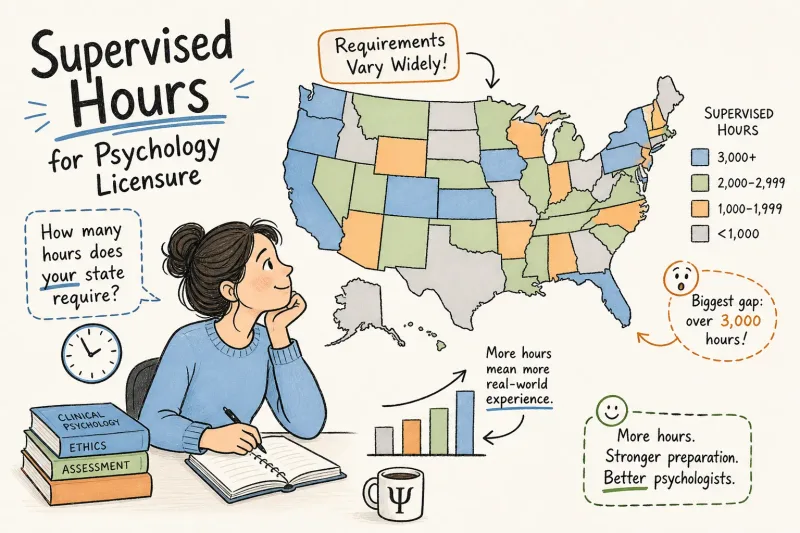
Supervised hours for psychology licensure vary by state because each licensing board sets its own education, experience and documentation rules. Many jurisdictions describe roughly two years of supervised experience, but the total alone cannot tell you whether a particular hour will count.
How many supervised hours are required for psychology licensure?
There is no single U.S. requirement. ASPPB states that a majority of jurisdictions require two years of supervised experience, while each board decides how that experience must be completed.
Some states divide experience between doctoral training and postdoctoral practice. Others permit more flexibility but impose their own conditions on settings, activities, supervisors and forms.
This is why a static 50-state number list can mislead. A listed total may omit a required postdoctoral portion, a weekly cap or a rule that disqualifies the supervisor.
This article explains how to read and verify psychologist licensure requirements. It is educational information, not legal advice or a substitute for a written decision from a licensing board.
Why do psychology licensure hours vary by state?
Professional licensure is a state or territorial function. Boards protect the public through local laws and regulations, so their definitions of acceptable supervised experience are not identical.
Differences often concern when experience occurs, whether practicum counts, how much client contact is needed and how often supervision must happen. They may also address supervisor credentials, remote supervision and required forms.
| Question | What a board may regulate | What to verify |
|---|---|---|
| Total experience | Required hours or years | The current rule and effective date |
| Training stage | Predoctoral, internship and postdoctoral portions | When an hour becomes eligible |
| Activities | Direct service, assessment, research, documentation and consultation | Definitions, ratios and caps |
| Supervision | Frequency, individual or group format and remote contact | The exact supervision standard |
| Supervisor | License type, standing, experience and board approval | Eligibility before the first hour |
| Proof | Agreements, logs and verification forms | Who signs and when forms are due |
What do current supervised-hour rules look like by state?
The examples below show why the components matter. They are not a complete national table and were checked against official sources on August 26, 2026.
| Jurisdiction | Current official example | Planning implication |
|---|---|---|
| California | 3,000 hours of supervised professional experience, with at least 1,500 earned postdoctorally | A qualifying total without the postdoctoral minimum is not enough |
| Texas | The March 2026 rulebook contains route-specific supervised-experience rules, including a 3,500-hour minimum for the industrial and organizational route described in section 463.11 | Read the subsection that applies to the degree and license route rather than copying one number across applicants |
| Every other jurisdiction | The applicable board's current statute, rule, instructions and forms control | Confirm the total and every condition with the intended board |
California's board also explains timing, documentation and weekly credit rules in its supervised-experience FAQs. Those details show why the same number of worked hours can produce a different amount of licensure credit.
What work may count toward supervised experience?
Boards may recognize direct psychological services and related professional activities. Direct work can include assessment, intervention and consultation with a client or system, depending on the rule.
Related work can include report writing, treatment planning, case consultation, record review and other activities tied to psychological services. A board may define or limit these categories differently.
Training level matters too. Practicum, internship and postdoctoral work are not interchangeable labels. The program and board must classify the experience under the applicable rule.
- Was the activity within the lawful scope of the training role?
- Did the setting qualify under the board's rule?
- Was an eligible supervisor responsible for the work?
- Did supervision occur at the required frequency and format?
- Were hours recorded on the correct forms?
- Did any weekly, activity or group-supervision cap apply?
Who can supervise psychology licensure hours?
A licensed psychologist is commonly required, but the words “licensed psychologist” may still be incomplete. Boards can require a period of active licensure, good standing, supervision training or approval of the arrangement.
A counselor, social worker, physician or another clinician does not automatically qualify to supervise hours toward psychologist licensure. Their work may be valuable while still falling outside the board's required supervision relationship.
Identify the supervisor of record before training begins. Informal guidance from several team members may not replace the designated relationship and documentation required by the board.
Does remote supervision count?
Remote supervision may count when a board allows it and the arrangement meets its conditions. Rules can address synchronous video, technology, privacy, location and the amount of remote contact.
Do not assume that telehealth service rules also govern supervision. Providing a service remotely and receiving supervision remotely are separate regulatory questions.
Keep a copy of the rule and any board communication that supported the arrangement at the time. Regulations can change before an application is reviewed.
Do forensic psychology placements count toward licensure?
A forensic placement can count when it satisfies the same board rules as other supervised psychology experience. The label “forensic” does not make the hours eligible.
Court clinics, correctional facilities and secure hospitals may involve assessment, treatment, consultation and team work. Confirm which activities the board recognizes and who holds formal responsibility for supervision.
Role clarity matters because trainees may receive operational direction from attorneys, physicians or administrators. Licensure supervision still needs to meet the psychology board's standard.
Students choosing a program should compare these rules with the doctoral training route and the duties described in real forensic psychology careers.
How do you verify your state's psychology licensure hours?
- 01
Choose the intended jurisdiction
Requirements cannot be evaluated without knowing the board that will decide the application.
- 02
Open the official board website
Find the current statute, regulations, applicant instructions, supervision agreement and verification form.
- 03
Build a requirement sheet
Record the total, training stages, activities, supervision format, supervisor qualifications, caps and documentation.
- 04
Map the actual placement
Compare the program's written training plan with each board requirement instead of relying on the placement title.
- 05
Ask precise questions in writing
If a rule is unclear, describe the degree stage, setting, duties, supervisor and format to the board.
- 06
Preserve evidence
Keep agreements, weekly logs, evaluations, supervisor license details and final verification documents.
How should supervised hours shape degree planning?
Work backward from the license and state, not from a program's marketing label. A forensic psychology concentration can be relevant without meeting every requirement for psychologist licensure.
Ask a program where recent students completed practica and internship, who supervised them and how the program documents experience. Then compare those answers with the board's primary documents.
Online coursework does not remove in-person training and licensure requirements. Our guide to online forensic psychology programs explains the distinction between course delivery and supervised professional experience.
The complete forensic psychologist pathway connects education, internship, supervised experience, examinations and state licensure in the order applicants usually encounter them.
Common questions about supervised psychology hours
How much clinical supervision is required to become a licensed psychologist?
There is no single national number. Many U.S. jurisdictions require about two years of supervised experience, but total hours, timing and qualifying activities vary. The licensing board for the intended jurisdiction is the controlling source.
Do supervised practicum hours count toward psychologist licensure?
They may count in some jurisdictions when the program, setting, supervisor and documentation meet the board's definitions. Other boards place limits on practicum credit or focus on internship and postdoctoral experience. Written confirmation before training is safer than relying on a program summary.
Is postdoctoral supervised experience always required?
No. Some jurisdictions require a defined postdoctoral portion, while others permit approved supervised experience to be completed at different stages. Rules can change, so applicants should confirm the current regulation and application instructions for their target board.
Can a counselor or social worker supervise psychology licensure hours?
Usually the board requires supervision by a psychologist who meets specific license, experience and training conditions. A related mental health license does not automatically qualify someone to supervise hours toward psychologist licensure.
Does remote supervision count for psychology licensure?
It depends on the jurisdiction, period of training, technology and supervision format. Some boards allow synchronous video under stated conditions, while others restrict the amount or require in-person contact. Confirm the rule in writing before counting remote hours.
Can supervised hours transfer to another state?
They may transfer if the receiving board finds the experience substantially equivalent to its own requirements. Approval is not automatic. Keep detailed records and ask the receiving board how it evaluates out-of-state experience.
Do forensic psychology placements count toward licensure?
They can count when the activities, setting, supervisor and documentation meet the board's requirements for supervised psychology experience. A placement's forensic label does not guarantee acceptance.
Where can I find current requirements for my state?
Start with the official psychology licensing board for the state or territory. Use its current statutes, regulations, application instructions and supervision forms. ASPPB provides jurisdiction information, but the board makes the licensing decision.
Sources
Official regulator, accreditation and state-board materials were selected because supervised-experience rules can affect licensure eligibility. Sources were reviewed on August 26, 2026.
- Association of State and Provincial Psychology Boards. Requirements to Practice.
Explains that jurisdictional boards set requirements and that a majority require two years of supervised experience.
- Association of State and Provincial Psychology Boards. EPPP Exam Types.
Confirms that each jurisdictional board determines its own requirements and approves applications to practice.
- Association of State and Provincial Psychology Boards. Psychology Licensure Guidelines.
Provides regulatory guidance, including resources related to practicum and supervision leading to licensure.
- California Board of Psychology. Application for Licensure as a Psychologist.
Current official instructions state a total of 3,000 hours of supervised professional experience, including at least 1,500 postdoctoral hours.
- California Board of Psychology. Supervised Professional Experience FAQs.
Official explanations of eligible experience, timing, documentation, weekly limits and supervision for California applicants.
- Texas Behavioral Health Executive Council. Statutes and Rules.
The official rules page links the psychology rulebook and the controlling Texas Administrative Code chapters, including supervised-experience provisions.
- American Psychological Association. Accredited Programs.
Official directory for checking APA accreditation status of doctoral, internship and postdoctoral residency programs.